
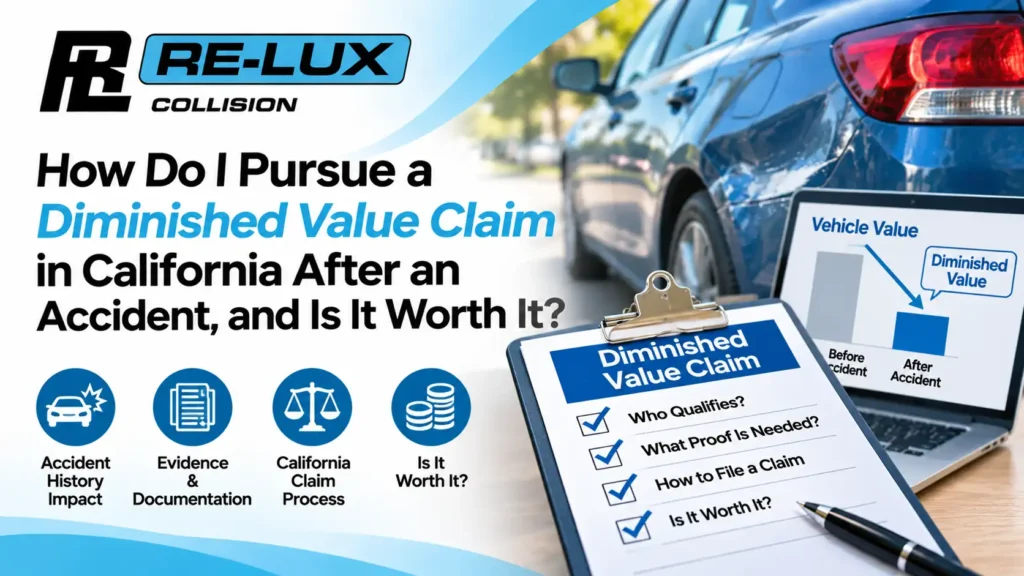
How do I pursue a diminished value claim in California after an accident and is it worth it? California generally allows you to seek compensation when another driver causes an accident that reduces your vehicle’s market value, even after proper repairs. You typically pursue this claim through the at-fault driver’s insurance company. Whether it is worth pursuing depends on the value lost, the evidence available, and the effort required to support your claim.
If your car has been repaired after an accident in Sacramento, you may still wonder what happens when you eventually sell it. A buyer might offer less because of its collision history, even if the repair looks excellent. A diminished value claim may help address that remaining financial loss.
What Is a Diminished Value Claim in California?
A diminished value claim seeks compensation for a vehicle’s loss in market value after an accident, separate from the cost of repairing the damage. The claim focuses on what your car is worth compared with what it would have been worth without the accident.
For example, imagine two otherwise identical vehicles for sale in Elk Grove. One has never been in an accident, while the other has a documented collision history and completed repairs.
Some buyers may prefer the vehicle without an accident history or offer less for the repaired one.
That difference can represent diminished value. However, you must support the amount of the loss rather than assume every accident creates a recoverable claim.
What Are the Three Types of Diminished Value?
The three commonly discussed types of diminished value are inherent, immediate, and repair-related diminished value. Each describes a different reason a vehicle may lose market value after an accident.
The table below explains these categories and how they relate to claims.
| Type | What It Means | How Commonly It Is Pursued |
|---|---|---|
| Inherent diminished value | Value lost because the vehicle has an accident history, even after proper repairs | Commonly the main focus of diminished value claims |
| Immediate diminished value | Difference between the vehicle’s value before the accident and its damaged value before repairs | Less commonly pursued as a separate post-repair claim |
| Repair-related diminished value | Additional value loss caused by incomplete or poor-quality repairs | Raised when repair quality affects vehicle value |
These are valuation categories, not separate insurance benefits automatically available under every policy. The legal basis and evidence for recovery depend on the circumstances of your claim.
Who Can File a Diminished Value Claim After a California Accident?
Drivers who were not responsible for an accident are generally the strongest candidates for a diminished value claim against the at-fault driver’s insurance company. This is called a third-party claim.
For example, if another driver hits your parked vehicle in Carmichael, you may seek compensation for eligible property damage, including a supported loss in market value.
Claims under your own collision or comprehensive policy work differently. Most standard personal auto policies do not separately cover inherent diminished value after proper repairs, but your exact policy terms control.
Fault, available liability coverage, and previous claim settlements can also affect your options.
If you have already accepted a settlement, review any release you signed before pursuing additional compensation. A release may limit further claims arising from the accident.
What Evidence Do You Need for a Diminished Value Claim?
A diminished value claim generally needs evidence of the accident, completed repairs, and a measurable reduction in the vehicle’s market value. The insurer must be able to evaluate the loss you are claiming.
Useful documents include:
- Accident documentation: Keep photographs, claim information, and available accident reports showing what happened.
- Repair records: Save the final invoice, parts information, and documentation of completed collision repairs.
- Vehicle history: Gather mileage, service records, previous damage information, and vehicle condition details.
- Independent appraisal: Consider a qualified diminished value appraiser who can assess the vehicle’s market value.
- Comparable vehicle sales: Research similar vehicles with and without accident histories to support the claimed difference.
A professional appraisal may help, but it does not guarantee that an insurer will accept the amount.
The stronger your documentation, the easier it is to explain why the accident caused a specific loss rather than relying on a general estimate.
How Do You Submit a Diminished Value Claim in California?
You generally submit a diminished value claim by contacting the responsible driver’s insurer, requesting compensation for the remaining loss, and providing evidence of that loss. The claim may be handled separately from the vehicle’s physical repair payment.
A practical process is to:
- Confirm claim details: Identify the responsible insurer and obtain the existing claim number.
- Complete the repairs: Keep documents showing the work performed and the vehicle’s repaired condition.
- Assess market value: Obtain reasonable evidence of the vehicle’s value with and without its accident history.
- Submit your request: Send the valuation and supporting documents to the claims adjuster.
- Review the response: Ask how the insurer evaluated your claim if its offer differs from your evidence.
Keep copies of your submission and written communication. Ask the adjuster what additional information is needed rather than assuming the initial response is final.
How Long Do You Have to File a Diminished Value Claim in California?
California generally allows three years to file a lawsuit for property damage, including a diminished value dispute arising from a vehicle accident. This period usually runs from the date the damage occurred.
California Code of Civil Procedure Section 338 governs the general property damage deadline. A different rule, Section 335.1, generally allows two years for personal injury lawsuits.
These are court filing deadlines, not guaranteed periods for submitting an insurance claim. Insurance notification requirements and certain legal exceptions may involve different timelines.
Waiting can also make valuation harder. As your vehicle gains mileage and gets older, separating accident-related loss from normal depreciation becomes more difficult.
The California Courts’ statute of limitations guide explains these general deadlines. Claims involving government entities may have much shorter requirements.
Is Filing a Diminished Value Claim Worth the Effort?
Filing a diminished value claim may be worthwhile when the potential recoverable loss justifies the time and expense of gathering evidence and negotiating with the insurer. Not every accident creates a loss large enough to make the process practical.
Consider these factors before deciding:
- Vehicle age and condition: Newer vehicles in good condition may have more market value affected by an accident history.
- Damage severity: Significant collision damage may affect buyer confidence more than minor cosmetic repairs.
- Existing accident history: Previous damage can make it harder to isolate the value lost in the latest accident.
- Appraisal expenses: Professional valuation may cost money, so consider whether the potential claim supports that expense.
- Time and effort: The process may require additional documents, insurer discussions, or legal action.
An insurer may dispute whether diminished value exists or offer less than you request. A supported claim is not an automatic payout.
What Can You Do If an Insurer Denies Your Diminished Value Claim?
If an insurer denies your diminished value claim, you can request a written explanation, review its reasoning, and consider submitting stronger evidence. A disagreement over market value may require additional documentation.
If you believe an insurer handled the claim improperly, you can contact the California Department of Insurance about its consumer complaint process.
You may also consider small claims court if your dispute meets the applicable requirements and limits. Court action requires identifying the proper party and filing within the legal deadline.
The Department of Insurance can review claim handling concerns, but it does not automatically decide every disputed vehicle valuation in your favor.
If the amount or legal issues are significant, speaking with a California attorney can help you understand your options.
Why Does a Well-Documented Collision Repair Matter?
A well-documented collision repair in Sacramento helps support a diminished value claim by showing what damage was repaired and how the work was completed. Clear records make it easier to separate accident history from concerns about unfinished repairs.
For example, a driver in Folsom may need documentation of replaced body panels, structural measurements, or completed electronic safety checks.
Keep the final invoice and any available supporting repair documents. These records can also be useful when selling the vehicle or answering questions from a future buyer.
A body shop can explain its repair documentation, but it does not determine the insurer’s legal liability or guarantee diminished value compensation.
Our article on how an auto body shop can help with an insurance claim explains the shop’s role in the broader claims process.
Frequently Asked Questions
Can I file a diminished value claim after an accident in Sacramento?
You may file a diminished value claim after an accident in Sacramento if another driver was responsible and you can support a loss in market value. The insurer will review liability and evidence. Compensation is not guaranteed.
Is a diminished value claim worth pursuing for a newer car in Elk Grove?
A diminished value claim for a newer car in Elk Grove may be worth pursuing when the accident has measurably reduced its resale value. Compare the potential loss with appraisal costs and the effort needed to support the claim.
Can I claim diminished value if I caused the accident in Carmichael?
Claiming diminished value after causing an accident in Carmichael is generally difficult under standard personal auto insurance. First-party collision policies commonly do not cover inherent diminished value. Review your specific policy and ask your insurer about available coverage.
How long do I have to pursue diminished value in Folsom?
You generally have three years to file a property damage lawsuit involving diminished value after an accident in Folsom. Insurance reporting requirements may be different. Special circumstances can change legal deadlines, so confirm the dates that apply to your case.
Do I need an appraisal for a diminished value claim in Rancho Cordova?
A diminished value appraisal is not automatically required for every Rancho Cordova claim, but it may provide useful evidence. Comparable sales and vehicle records can also help. The insurer may request additional proof before evaluating your claim.
Can I claim diminished value after my Porsche is repaired in Sacramento?
You may be able to claim diminished value after your Porsche is repaired in Sacramento if another party caused the accident and the vehicle has a supported loss in market value. Its condition, accident history, and repair records will affect the evaluation.
Can Re-Lux Collision help document repairs for a diminished value claim?
Re-Lux Collision can help document repairs by providing available records of the collision work performed on your vehicle. These documents may support a diminished value claim in Sacramento. The insurer or legal process determines whether compensation is owed.
Understand Your Options Before Pursuing Diminished Value
California allows drivers to pursue supported property damage losses that may remain after a vehicle has been repaired. Diminished value claims are generally directed toward the responsible driver’s insurer and require evidence of reduced market value. The potential recovery, documentation costs, and legal deadlines should guide your decision.
This article provides general information, not legal advice. Verify your specific rights and deadlines with your insurer, the California Department of Insurance, or a qualified attorney.
If your vehicle needs collision repairs or you have questions about documentation for completed work, contact our Sacramento auto body shop, Re-Lux Collision. We focus on complete, well-documented repairs that can help you maintain accurate vehicle records, whether or not you pursue a diminished value claim. Serving Sacramento, Elk Grove, Carmichael, Folsom, Rancho Cordova, and surrounding communities, we are located at 6580 Asher Ln Ste 300, Sacramento, CA 95828. Call (916) 240-2000 to discuss your vehicle and repair documentation.